

MPC Guidance for APS agencies on building an effective system of review
-
Part 1 Principles.pdf (PDF - 111.95 KB)
-
Part 2 Policy.pdf (PDF - 143.54 KB)
-
Part 3 Practice (PDF - 257.21 KB)
Part 1 Principles
As an Australian Public Service agency, your review policy and procedures must, at a minimum, be consistent with the Employment Principles set out in the Public Service Act 1999 (the Act) and Public Service Regulations 2023 (the Regulations).
This first part of the MPC guidance highlights the key principles that underpin an effective system of review. Use these principles to develop your system and maximise the benefits reviews can offer.
Figure A How to build a positive review culture
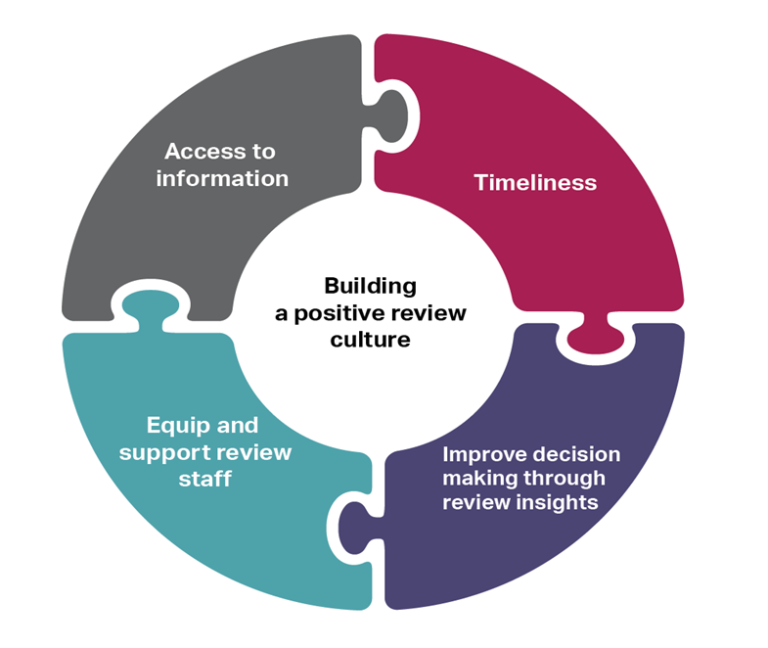
Access to information
APS employees (excluding SES) have a legislated right to seek a review of a decision related to their individual APS employment.
This system of review is called the Review of Actions scheme (the scheme). It is about making sure employment related decisions are lawful and fair. Of course, that goal can only be achieved if your staff are aware of their entitlement.
This principle is about encouraging agencies to make sure employees know about their entitlement to seek a review, and are given genuine access to exercise that right, at the time they need to use it. An employee is likely to only seek information about the review process when they are not happy with a decision.
Wherever possible, think about the reasons your staff may not feel safe or comfortable to seek a review of a decision. There may be historic, cultural or operational reasons why an employee may choose to not to complain or raise a concern. Equally, there may be environmental reasons for why a manager may not inform their staff about the review right. Most of those barriers can be addressed with clear, consistent and positive messaging about the scheme, which focuses on its benefits to both employees and agencies – such as improved decision making, supporting conflict resolution, enhancing accountability transparency and integrity. Make a statement that reprisal action for seeking a review will not be tolerated.
A fully engaged and open approach to the scheme shows a commitment to building a productive, engaged and safe workplace.
Equip and support review staff
Part 3 of this MPC Guidance shows the complexity of the scheme’s jurisdiction.
A review process and outcome must be lawful, procedurally fair and able to withstand external scrutiny. There are eligibility requirements, discretionary powers and administrative rules that must be met. In addition to this, the Regulations expect reviews to be completed as quickly and informally as possible and with the option of alternative dispute resolution where appropriate.
Reviewers need to understand and manage these competing requirements and priorities. It is therefore important to properly equip, train and support your review staff and recruit for the unique and specialised skills needed to undertake reviews and handle complaints.
Have adjacent proactive safe workplace policies to support review staff deal with psychosocial hazards, including exposure to sensitive subject matter or material, high workloads, managing aggressive or unreasonable conduct and strategies for early detection of vicarious trauma and burn out.
Timeliness and communication
Timeliness and communication matter. It builds trust in the process, prevents escalation and reduces potential requests for secondary review by the MPC. In our experience, an applicant is more likely to have confidence in the process (and accept an unwelcome outcome) if their issues are dealt with, and responded to, promptly.
While it is not always possible to set strict timeframes for completing a review, there are stages of the review process where you can be definitive – for example acknowledging a request for review, providing advice on the progress of an application and building regular updates into the review process – even if there is no new information to share.
Be open about the factors that may change the timeframe or deadline for completing a review. The time it takes to complete a review will depend on the type of decision under review.
Making timely decisions, and providing that advice promptly, shows a commitment to the principles of good decision making, and to meeting your obligations under the Regulations.
Improve decision making through review insights
While a primary purpose of the scheme is to address and resolve an individual employees’ concern, at an organisational level it can be used to improve decision-making.
Review data can give invaluable insights into what is happening in your agency. It can be used with other information to identify emerging or unresolved issues with certain groups or individuals. It can be evidence on how well a team or policy is functioning and identify inefficient or ineffective systems.
Reviews can suggest improvements to a practice or approach (irrespective of whether the original decision was set aside or varied). It can show training needs and capability gaps – noting the privacy requirements to report only on high-level, de-identified data. A review outcome may recommend changes to a policy or a process that will resolve problems and therefore have a positive effect on other staff.
Take steps to understand what may be generating applications for review or where there is an absence of applications. Don’t assume that having small numbers of applications for review is evidence of a healthy and effective workforce.
Part 2 Policy
This chapter sets out how to draft a review policy that is accessible, fair and takes a strategic approach to managing reviews. The policy should build on the principles in Part 1 and interact with the procedures set out in Part 3.
Figure B: The steps of an effective system of review
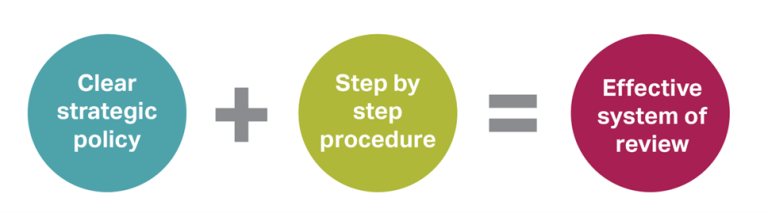
Explain the purpose of the policy
The purpose of the policy is to explain how reviews will be conducted in accordance with the Public Service Act 1999 (the Act) and Public Service Regulations 2023 (the Regulations). It should explain roles and responsibilities, set behavioural expectations for all parties, and commit to a set of principles to guide practice.
Use the key components discussed in Part 1 to show your commitment to:
- deal with employee’s concerns informally, quickly, and fairly
- build a workplace culture that encourages employees to raise concerns
- make information about the review process easy to find when it is needed
- inform staff that when they raise issues, they will be protected from reprisal action
- use insights, data and information to continuously improve by identifying good practice in decision making and resolving disputes.
If there are recommendations, observations or suggestions for improvement, provide those details to the relevant parties. Where appropriate, actively promote that those improvements were a result of a review.
Delegations
The management of delegations is crucial to the legitimacy of employment decisions and actions made in the APS.
The Regulations give the power to review a decision to the Agency Head. This decision-making power can be delegated to a person in your agency, or a suitable person in another APS agency. Information about the power to delegate and delegation instruments can be located on the APSC website.
As an APS agency you should have an instrument of delegation, with a policy to regularly review and update the instrument as roles change. Provide links to the instrument in your review policy to embed the process of checking who has the authority to review a decision. If a decision is made to outsource the review, formalise and record the process of delegating those powers as soon as possible.
The policy can set the expectations on when and how a delegated decision maker can seek assistance from another staff member or someone external from your agency to assist with the review.
Document what is in and out of scope
Section 33 of the Act gives the broad entitlement to seek a review. The Regulations then place limits on the types of decisions and actions that can be reviewed. Part 3 of the MPC Guidance has practical advice for review practitioners on how to assess which types of actions and decisions are reviewable under this part of the Regulations.
However, your policy and procedure can include actions that may otherwise be excluded from the scheme. For example, you may decide to extend your review policy to include SES employees. There are benefits to this approach. It offers a fair and transparent process to all staff on how a complaint or concern will be treated and a clear path to de-escalate or address grievances.
In that situation, the policy will need to be noticeably clear that the eligibility criteria set out in Part 3 of the MPC Guidance only applies to employees who have the status under the Act to seek secondary review by the MPC and judicial review.
The policy can not apply to a Code of Conduct breach or sanction decision. These matters can only be reviewed by the MPC or, where a sanction is termination of employment, the Fair Work Commission.
Some concerns may also be resolved through dispute resolution provisions in your agency’s Enterprise Agreement. Have the policy set expectations that serious concerns about criminal and corrupt conduct are referred to the relevant authority.
Provide links to legislation, resources and key-terms
Highlight the Employment Principles which provide for fair employment decision-making with a fair system of review.
Include lines to relevant references, resources and legislation including the Public Service Act 1999, Public Service Regulations 2023 and Australian Public Service Commissioner’s Directions 2022.
Have a section for agencies with links to resources that educate and inform staff of their obligations and responsibilities. For employees, they will need information on understanding how to exercise their rights, escalate their concerns or resolve their problem.
Useful information includes policies relating to your agency’s performance management framework, links to the Enterprise Agreement, policies on the management of complaints about harassment and bullying, safe workplace culture frameworks. Include information about other complaint and resolution processes such as MPC, the Fair Work Commission, the Australian Human Rights Commission and the Office of the Australian Information Commissioner. Provide a definition of key terms and acronyms to assist with accessibility.
Options to resolve a dispute
The policy should specifically note that a concern or dispute can be resolved at any time in the review process. For example, where there is a clear middle ground or there is potential for simple clarification of the issue.
Resolution however is not a requirement or a mandatory first step in the process – an employee has the right not to accept an offer of dispute resolution.
Explain merits review
Your review policy can explain ‘merits review’, while noting the Regulations requires the process to be completed as quickly and informally as the circumstances allow.
It will be useful to include a short, high-level explanation of merits review and the rules, requirements and non-discretionary elements underpinning the process of review.
At a minimum, the policy should refer to the key characteristics of merits review, which are:
Merits review is where an independent person ‘stands in the shoes’ of the original decision maker, to have another look at the decision and decide if it was fair and reasonable in the circumstances.
The reviewer will consider all the relevant information - which may include new information that was not before the original decision maker. The reviewer takes the applicant’s individual circumstances into account and then decides what is the correct and preferable decision.
The decision subject to review will continue as though an application for review has not been made. It will only be changed if the review outcome varies or sets aside the decision.
Under the scheme, review outcomes are limited to:
- confirming the original decision (so the decision remains), or
- varying aspects of the decision, or
- setting aside the decision.
Your policy should explain that, once the review is completed, the employee will be advised, in writing, of the outcome and the reasons for the decision.
Applicants will be informed how they can seek a secondary review of the original decision by the MPC and of the 60-day deadline to making an application. This entitlement to seek a secondary review by the MPC extends to those decisions that you have assessed as not being eligible for review.
Further explanation and instructions on how to conduct a lawful and valid merits review are in Part 3 of the MPC Guidance materials.
Milestones and updates
Commit to completing reviews in a reasonable time, noting that this will depend on the nature and circumstances of the decision subject to review. If there are delays to completing the process of review, your policy should assure that progress updates will be given at regular intervals.
On a practical level, an applicant’s frustration with delay or a lack of advice on the progress of their application will increase with time – especially if there has been no progress updates or reasons for delays. Keep track of the process of each review until it has been finalised. Have a system to monitor the progress of the reviews and build in milestones to provide progress reports
If an applicant’s expectations about time are well managed from the outset, and updates are provided regularly, it will likely reduce the number of contact or enquiries about the progress of the review.
Procedural obligations
While the review process is required to be completed as quickly and informally as possible, it must also be conducted in accordance with principles of procedural fairness. Your policy should make it clear that there is a non-negotiable obligation to provide procedural fairness and explain how this will be achieved.
For example, the policy will provide for:
- a process that is fair
- where decision makers are free from bias, and
- anyone whose interests might be adversely affected is given an opportunity to respond and have their response considered before a decision is made
Make it clear that reviewers must actively consider (and make a record) of why the employee believes the decision under review was unfair, unreasonable or inconsistent with a policy or procedure.
Protecting everyone’s privacy
The Regulations require all reviews to be conducted in private. This means the application and all information related to the review are not shared with anyone who does not have a ‘need to know’.
The policy should refer to how you will hold personal information and protect it from loss, misuse interference and unauthorised disclosure. You are bound by the Archives Act 1983 to retain Commonwealth records until it can be lawfully disposed of. Have links to your agency retention policy.
Important privacy requirements to include in the policy are:
- reference where review records are stored and who can access those records
- advice on how long records are kept on file
- information on how to request access to personal information on a review file – and the details of the agency Privacy Officer
- advise how the Privacy Act 1988 and the Freedom of Information Act 1982 (FOI Act) may apply.
Representatives, advocates and support people
An applicant may seek to involve a lawyer or union delegate to act on their behalf during the review process. Your agency’s policy can set expectations on the role of legal representatives in the review process and have clear guidance for reviewers on how to manage an adversarial representative.
Applicants may also seek to be supported by a union representatives or support person. Your policy can give advice on the responsibilities, the boundaries and expected behaviours of a support person.
Review your policy
Review your policy as necessary to ensure it remains aligned with legislation, government policy, organisational changes or changes to the working environment.
Take note of amendments to legislation. Be proactive in updating information when there have been changes and share information about those changes at team meetings, weekly emails or internal newsletters.
It is good practice to maintain a version history.
| Version | Authorised by | Revision date | Author | Description of change |
|---|---|---|---|---|
Part 3 Practice
Part 3 is the final part of the MPC Guidance. It is a practical tool that walks you through each step of the review process.
Figure C The scheme in practice
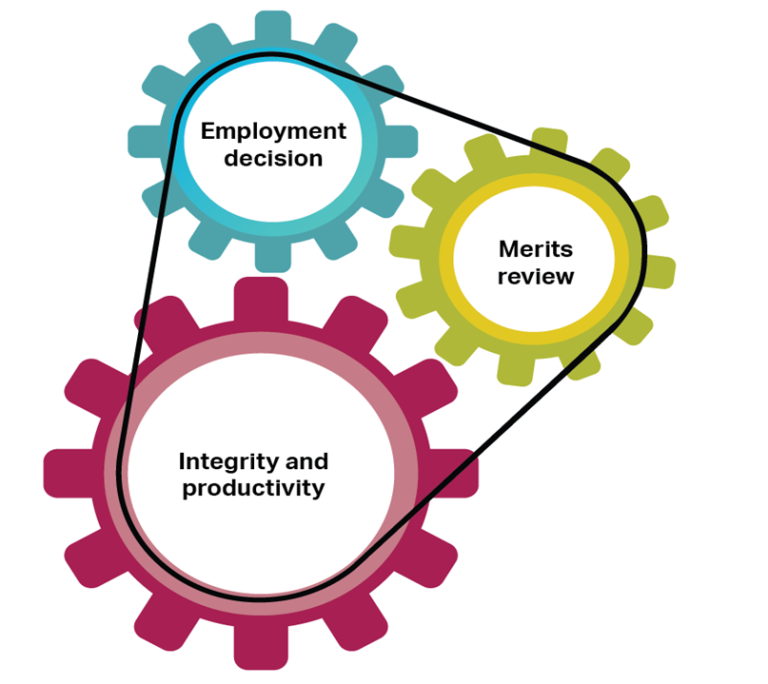
Step 1: Delegations
The first step is to check your agency’s instrument of delegation to confirm who has the power to make a review decision. There are limits on who may be delegated a power or function. Whoever it is, make sure there is formal written record of the delegation on file.
The decision-maker should be a suitably experienced and independent person in the agency. It can also be someone from another APS agency. Wherever possible, the decision maker should have had no previous involvement in the original decision – such as providing advice to any person involved in the decision under review.
Consider the seniority of the original decision maker when delegating decision making powers - to avoid any perception of influence or questions about objectivity.
The decision maker can have another person to assist with gathering evidence, complying policy documents and making a recommendation.
If required, the decision-making power may be given to a person external to the APS, however this requires approval from the APS Commissioner.
Step 2: Assess for eligibility
Assessing a request for a review of an employment related decision can often be complex and may take time to consider the factors and apply the exclusions. Your procedures should reflect this and allow for a careful and considered assessment to be conducted and which take account of all the individual circumstances. The MPC has a tip sheet on determining review eligibility.
An application form with clear instructions can collect all the relevant information needed to assess eligibility and determine if a review is justified in the circumstances. Ask for relevant dates, times, who is involved, details of the decision, why the applicant is seeking a review and what outcome is being sought.
Have a secure and confidential group inbox or portal to receive the application forms. This is a simple way to reduce barriers to seeking a review and ensure the privacy principles are being met.
2.1 Initial contact with the applicant
Contact the applicant to clarify and verify information needed to complete the assessment.
If it’s clear that an application is not eligible for review from the outset, provide that advice to the applicant as soon as practical, with reasons why.
This is the stage when you can begin to manage expectations on timeframes. You can also consider whether some form of dispute resolution may be an option. (See 2.8 Is resolution an option).
If the applicant seeks to have a support person or lawyer to act for them, refer to your agency’s review policy for guidance.
2.2 Establish eligibility to seek a review
Assessing an application under this section only applies to those employees who have an entitlement to seek a review under the scheme. For employees such as SES who are excluded from the scheme, you can still apply similar rules and requirements to afford consistency and transparency across all staff.
Under the scheme there is review entitlement where:
- the application is made by an APS employee (excludes SES)
- the application is about an APS action, which
- is related to their individual employment.
The assessment process is not always a simple tick-box process. There are many variables, and individual factors to consider and legislative requirements to apply.
Table 1 – 3 steps you through the initial checks to be conducted to determine eligibility.
Table 1 APS employee
| Must be | Description |
|---|---|
| An APS employee | Is a person employed as an APS employee under the Act. If the employee has resigned, been terminated before the review is completed, or if a non-ongoing contract comes to an end, they will no longer have an entitlement to a review. A decision to terminate a person’s employment is specifically excluded from review by s 33(1) of the Act. Decisions to terminate an employee’s employment (for whatever reason) can only be reviewed by the Fair Work Commission. |
| Ongoing, non-ongoing or casual employee | Ongoing, non-ongoing or casual APS employees are eligible for review under this part of the scheme. |
| Not a Senior Executive Service (SES) employee | Only employees with a classification of APS1- 6, EL1 - EL2 can apply under the Regulations. APS employees in acting SES roles can apply for review of a decision. A decision made by an SES officer can be a reviewable decision. |
Table 2: APS action
| Must be | Description |
|---|---|
| An APS action | An action is a thing done or said, a process followed and/or decision that has been made. The Macquarie Dictionary defines an action as ‘Something done; an act; deed … conduct’. |
| Includes a refusal or failure to act | An action or a decision includes a positive action and a decision not to take an action or make a decision. For example, a failure to act on a complaint about bullying or a delay in making a decision can be an APS action. |
| Made by an Agency Head or APS employee | An action must be made by the Agency Head or an APS employee. An action or decision made by consultants or contractors working alongside APS employees are not reviewable. Note: An action of a consultant or a contractor may be included in certain contexts. For example, if an APS employee complains to an agency about the actions of a consultant, contractor or statutory office holder, the agency’s response to that complaint may be a reviewable action. |
Table 3 In ‘relation to their employment’
| Must be | Description |
|---|---|
| A decision must have some impact or bearing on the applicant’s employment | An APS employee can only seek review of something in which they have a direct personal interest. This excludes seeking a review of a decision that has affected a colleague (for example, seeking review of an agency’s handling of allegations that a colleague was harassed). |
2.3 Was the application made in time
Section 37 of the Regulations require an application for review to be made within ‘60 days from when the original decision was communicated to the employee. An application made outside the 60 days is not eligible for review unless there is evidence of ‘exceptional circumstances’ to explain the delay.
Determining the date of an action or decision can sometimes be difficult. An application of review may involve a series of, or multiple decisions, some of which may have been made outside the 60-day limit. In these (limited) types of cases, the individual circumstances and context may be relevant. If the last decision or action is within time, it may be necessary to consider all previous decisions in order to conduct a meaningful review.
What are exceptional circumstances?
The employee must be able to demonstrate the exceptional circumstances that prevented them from applying within the 60 days. As a guide, if an employee is fit for work and able to attend usual duties then it is reasonable to expect they can apply for a review within 60 days - the application process is simple and does not require detailed information to be supplied at the outset.
Whatever the reason, the applicant will need to provide evidence to support their claim of exceptional circumstances.
Here are some examples of what an exceptional circumstance may be:
- where the applicant has been on a period of extended sick leave which significantly hindered their ability to apply
- if the significance or main impact of the decision or action under dispute only became known after 60 days from the date of the decision
The following circumstances are unlikely to be exceptional:
- the applicant forgot to apply or was too busy to apply
- a circumstance that was ordinary or usual for example moving to a new job or taking recreation or long service leave.
This is a case study on how the MPC determines exceptional circumstances.
2.4 Is the action or decision ‘reviewable’
Under the scheme not all employment related actions or decisions are reviewable. Section 37 of the Regulations lists the types of actions and decisions that are not included in the scheme.
The following table provides a description of each type.
Table 4(a) General actions or decisions that are not reviewable
| General actions excluded | Description |
|---|---|
| A strategic, policy or resourcing decision or a direction of the APS or an agency | These are actions and decisions that relate to high-level administration of an agency are not reviewable. For example - closing an office, relocation of a branch, declaring a function to be excess, a change of policy position or strategic direction. Employees can seek review of how a policy has impacted their individual circumstances. While the level of resources an agency gives to a function is not reviewable, it may be relevant if the employee argues that they are unable to meet performance targets because of inadequate resourcing. |
| Action taken, or not taken, in accordance with a direction or reference given by a Minister under the Act or another Act | This refers to matters other than the exercise of an employer power by the Agency Head or their delegate. For example, a direction from a Minister to an Agency Head on a high-level matter (not about an individual employee). |
| A direction by the APS Commissioner under the Act | The APS Commissioner can set standards for Agency Heads and APS employees on performance management, Code of Conduct breaches and the application of APS values. These decisions are no reviewable. |
| Actions and determinations related to a special inquiry or inquiry under section 43 or section 50 or section 50A of the Act | The APS Commissioner and the MPC have Inquiry functions under the Act. An employee is not able to seek a review of any recommendation or finding made as a result of an Inquiry under this part of the Act. |
| Decisions made under section 72 of the Act – usually called Machinery of Government decisions | There is no right of review of decisions made by a government that relate to a machinery of government – such as the creating, merging, and closing of agencies, the shifting functions between agencies and creation of new public policies. |
|
Actions made under the following Acts:
|
Actions taken in respect to an employee’s security clearances are reviewable unless it is a clearance that involves a decision by ASIO. These are not reviewable (though may be in the jurisdiction of the Administrative Reviews Tribunal (ART)).Workers Compensation decisions are not reviewable under the scheme. The actions taken by an agency in relation to administering superannuation contributions under any of the different scheme are also not reviewable. |
Table 4(b) Employment actions and conditions that are not reviewable
| Actions of employment and conditions that are excluded | Description |
|---|---|
| Actions relating to the engagement of an APS employee | Engagement refers to the employment of a person from outside of the APS. This includes all aspects of the selection exercise leading to an engagement are not reviewable. |
| Action of a reviewer who has undertaken a review under Division 2 of Part 4 of the Regulations | The MPC can review certain APS selection exercises and promotion decisions to determine if the process was merit based. Any actions arising from this process is excluded from the scheme. |
| An action that relates to a promotion decision of an APS employee as an SES employee | Any action about a decision to promote an APS employee to a senior executive role is not reviewable. |
| Action relating to the determination of duties of an APS is not reviewable < |
An Agency Head has the power to determine the duties of their employees and the place at which those duties are to be performed. These types of decisions are not reviewable under the scheme. See APSC guidance on the types of decisions which are an assignment of duties:
Exceptions There are some actions which relate to the assignment of duties which are reviewable. These include:
|
| Action relating to an Agency Head decision to not include the name of an APS employee in a notice in the Public Service Gazette | An employee’s name must be included in the Public Service Gazette except in certain circumstances. These decisions are not reviewable under the scheme. |
MPC primary review
In limited circumstances the MPC may agree to accept an application for a primary review, and only when:
- the Agency Head was directly involved in the action or decision, or
- it is not appropriate for the Agency Head to deal with the decision due to its sensitivity or seriousness, or
- it involves allegations of victimisation for making a previous application for review.
The MPC explains when an application may be accepted and the evidence required to support the application for review. An agency may refer a matter to the MPC,or an applicant may apply directly to the MPC.
2.5 Determine if the action ‘ceases to be’ reviewable
At any time during the review process, a decision or action can ‘cease to be reviewable’ in accordance with section 37(3) and (4) of the Regulations.
In determining whether a decision, or action is no longer reviewable requires careful consideration of all the circumstances and must take the policy objectives of the scheme into account. The assessment process must be well-documented, and reasons given to the applicant to explain the decision.
While the Regulations do not require you to seek the view of the applicant at this stage, the applicant must be given reasons, in writing, why your agency has decided not to conduct a review. The applicant is then entitled to apply to the MPC for a secondary review of the original decision.
Table 5(a) explains the circumstances where an action or decision ceases to be reviewable. Table 5(b) has the circumstances where the person conducting the review considers the action should not be reviewable.
Table 5(a) When an action ceases to be reviewable
| Reasons an action ceases to be reviewable | Description |
|---|---|
| The applicant has applied to have the action reviewed by a court or tribunal | If an applicant has already applied to a court or tribunal which has the jurisdiction to deal with the action, then it ceases to be reviewable. |
Table 5(b) Considerations for when an action may cease to be reviewable
| Considerations to take into account | Description |
|---|---|
| The application for review is misconceived or lacking in substance | Misconceived is when an applicant has been mistaken, has failed to understand or has misinterpreted or misconstrued the circumstances of the decision. Lacking in substance means the decision is without significant meaning, detail or importance. |
| The application for review is frivolous or vexatious | Frivolous is where the application is baseless, has no grounds or the argument being made is incorrect. It lacks merit, has a lack of serious purpose and not made in good faith. A vexatious application is intended to cause trouble, annoy or embarrass another party, is repetitive and/or an abuse of the review or a complaints process. |
| The action or decision has previously been reviewed | Once a decision has been reviewed (or assessed as not being reviewable) that decision by the delegate is final. There is no power that allows your Agency to conduct another review under the scheme. |
| Where a review by a different external body would be more appropriate | There are expert bodies set up under legislation to handle complaints about certain issues such as privacy breaches (the Office of the Australian Information Commissioner) or allegations of discrimination in the workplace (the Australian Human Rights Commission ). The Fair Work Commission is also able to handle issues related to bullying and sexual harassment. |
| Where the applicant does not have sufficient interest | Establishing whether an employee has sufficient interest is not always clear. If an employee has witnessed and been affected by conduct of a colleague, they may be able to establish sufficient direct personal interest to be eligible for review. |
| A review is not otherwise justified in the circumstances. |
In exercising this discretion, the reasons are not confined to the merits of the matter – it can take individual circumstances and external factors into account. The MPC has a tip sheet on applying this test of not otherwise justified . The types of situations where this section may apply include the following:
|
2.6 Advise applicant of assessment outcome
Inform the applicant of the assessment outcome as soon as practicable after the decision is made.
Where it has been determined not to accept the application for review, provide the applicant reasons and details of how they can apply to the MPC for a secondary review of the original decision and the 60-day timeframe.
Where a review is to be undertaken, explain next steps, timeframes and commit to provide updates if the review outcome is delayed for any reason. Give the applicant an opportunity to raise any concerns they may have about the reviewer or delegate prior to starting the review so that any perceptions of bias can be mitigated or managed. Applicants must have confidence the review process is fair and unbiased.
2.7 Is resolution an option?
An application for review is an expression of disagreement with a decision about something that has impacted the applicant’s employment. Each application requires a response under the legislation, and one of those options is resolution. It is not a pre-requisite to conducting a review.
Referring a matter for resolution is not to downplay or minimise a dispute. It can be suitable for when:
- there is the potential for clarification of an issue
- you can give clearer reasons or explanations for how a decision was reached
- where there is a clear middle ground.
Before proceeding, there must be a process of consultation with the original decision maker and applicant and any other relevant parties. All parties need to agree to the process of resolution.
There are circumstances where resolution may not be an option. Consider the interests, relationships and behaviours of the individuals involved. It will depend on the nature of the matter, the capability of the individual manager/delegate and level of employees’ trust in the process.
Eligibility checklist
◻ check review decision maker has delegations
◻ make initial contact applicant
◻ assess if entitled to review
◻ determine if action is reviewable
◻ contact applicant with advice on outcome of assessment and next steps
◻ if applicable, advise applicant about role of MPC and how to apply for secondary review
◻ file and maintain record of decision
Step 3: Work out the terms of reference
The reviewer gets to define the scope and should be given the resources needed to complete the review as quickly and effectively as possible.
The first step is to check the original decision-maker had the authority to make the decision. For example – a decision to suspend an employee can only be made by a person with the appropriate delegation. If not, then the decision must be set-aside.
3.1 Determine the scope
Define the limitations and purpose of the review process. Work out:
- what will be included, and what will not be considered
- any time critical issues
- how long you expect the review will take.
- Try to have contact with the applicant early in the process to clarify the key issues and if there has been any subsequent action taken that may have addressed or resolved their concerns.
Some disputes will involve multiple issues and cross over jurisdictions that may be out of scope – such as public interest disclosures and privacy breaches. Have those discussions early with the applicant about what will be included in the review.
3.2 Identify what evidence is needed and how to get it
Almost all decisions subject to review will have been made under an existing policy - such as performance management guidelines, bullying and harassment policy, leave policies, and flexible work policies.
At the start of a review, get access to the relevant policy, instruction, guidelines or operating procedures that relate to the decision. Take time to understand its contents and purpose. Check it is the correct year / version under which the decision was made.
If the evidence is clear and uncontested, or the consequences are not serious, a review may simply involve talking to the applicant, looking at existing documents and writing a review decision.
However, a review will often be looking at a decision where the f acts are in dispute and where there are contradictory witness statements of the same incident, such as :
- an employee’s level of performance
- a manager’s behaviour where the employee has said that they were bullied by the manager
- an employee’s record of attendance
- the appropriateness of behaviour between co-workers.
Make sure to:
- check the facts – names, dates, location, times
- only look at information relevant to the decision under review
- evaluate the evidence, apply logic, common-sense and experience - n ot all evidence, information or points of view are of equal weight
- check the original decision maker did not apply irrelevant considerations.
A reviewer looks at all the relevant information that was before the original decision maker. In some cases, new information can be considered – such as fresh evidence or factors that have arisen or occurred since the original decision was made.
Consideration of new evidence can result in the reviewer making a different decision to the original one - even if the original decision was correct at the time.
Did you know?
A reviewer can rely on common knowledge, their own judgement and apply their personal experience and knowledge when reaching their own decision. This can include general knowledge of good people management practice or acceptable standards of behaviour in a professional workplace.
3.3 Procedural fairness requirements
The Regulations require reviewers to ‘have due regard to procedural fairness’.
A procedurally fair process is where
- decisions are based on facts and made without bias
- the applicant understands the evidence that supports the decision and has been given a chance to respond to adverse or supporting evidence being considered by the reviewer
- there is evidence the applicant’s response was genuinely considered before a review decision was made – make a record how the information was or was not taken into account, with reasons.
Procedural fairness does not mean the applicant gets access to every document, piece of evidence or its source. If the substance of the evidence is put to the applicant – it can meet the requirements.
Unresolved questions or concerns about procedural fairness can corrupt an otherwise fair process, so address any conflict of interest quickly. Always make a record of any disclosure and its management and mitigation. A material defect in the procedural fairness of a review process can be result in a recommendation that a decision is set aside by the MPC or a decision by a court.
Step 4: Make a fair decision
A review is an opportunity to critically analyse evidence, query how a policy was applied, and have regard to the applicants concerns and individual circumstances. The reviewer can confirm the original decision, vary it in some way or set it aside.
However, a review is also an opportunity to make suggestions for improvements – even if confirming the decision.
Changing the original decision
The reasons for changing the original decision may include
- where there has been an error or mistake
- there was a procedural flaw, such as a failure to afford procedural fairness
- new facts or evidence have emerged or been located
- there has been a change in circumstances
- the original decision was based on a misrepresentation or a factual misunderstanding
- the original decision was not fair or reasonable in the circumstances.
Important practice note
Allow for flexibility when applying a policy or operational procedure. For example, the following circumstances may warrant changing the original decision:
- the decision under review was made in accordance with your Agency’s policy, however it resulted in an outcome that was unfair and not the intention of the policy
- the applicant’s personal circumstances were unique and compelling, with circumstances that invite a different, more compassionate response than was standard procedure
- the decision maker had a discretion to make a different decision but followed standard practice without thinking what was fair and reasonable in the circumstances.
Step 5: Write a report
The Regulations require the delegate to notify the applicant, in writing, of the:
- the decision
- the reasons for the decision
- any action taken as result
The level of detail and length of the report will be determined by the complexity and nature of the decision.
An outline of what is expected in a report can include:
- summary of the complaint/concern and the outcome the applicant is seeking
- a short description of the decision or action under review
- reference to the relevant policy framework and procedures
- the steps taken to conduct the review (interviews, contact with the applicant etc)
- the information / evidence that was gathered and considered
- details of how the original decision:
- was or was not consistent with relevant policy
- was or was not procedurally fair
- if another decision was more appropriate in the circumstances
- inform the applicant about their right to apply to the MPC for a secondary review and the 60-day time frame.
Step 6: Communicate the decision to all parties
Depending on the circumstances, and before issuing the decision, consider whether the employee may need support to engage with their team or their manager / original decision maker after the decision is issued. An applicant experiencing anxiety or other mental health challenges may also need to be supported to receive the outcome in a particular way.
It is also important to inform the original decision maker, especially when varying or setting aside their decision. Communicate the changes and include reasoning that led to the new or varied decision. Promote this as an opportunity to learn and improve.
Give managers clear expectations on how you expect them to respond to a decision to set aside or vary their decision.
Step 7: Hold and retain accurate records
The personal information about an applicant will be treated as a Commonwealth record. There are legislative requirements for how personal information and employment records should be kept, used and disclosed under the Archives Act 1983, the Freedom of Information Act 1982 and Privacy Act 1988.
Access to information for management purposes should be on a need-to-know basis. Where you have engaged an external delegate to make the decision, request copies of the documentation, and evidence relevant to the decision – including the employee responses – to hold on your own record management system.
Remember that the process may need to hold up to external scrutiny – such as secondary review by the MPC or judicial review. This will mean transferring all the documentation relevant to the original decision in an accessible and organised format.